Mirror Codex · public browser MIDI laboratory
Map what you have in your browser.
Connect a local MIDI controller, press pads, turn knobs, move faders, and build a small Mapping Universalis table without installing anything.
Mirror Codex treats each local gesture as a sentence: device, channel, message type, number, value and semantic name. This is the Mapping Universalis language layer that prepares a clear path toward UMP and MIDI 2 workflows without claiming a completed physical MIDI 2 endpoint test.
1 · Connect MIDI
Use Chrome or Edge on HTTPS for the smoothest Web MIDI support. Your browser will show its own permission prompt.
Detected devices
3 · Mapping table
2 · Capture a gesture
Name a target, click learn, then press or move something on your controller.
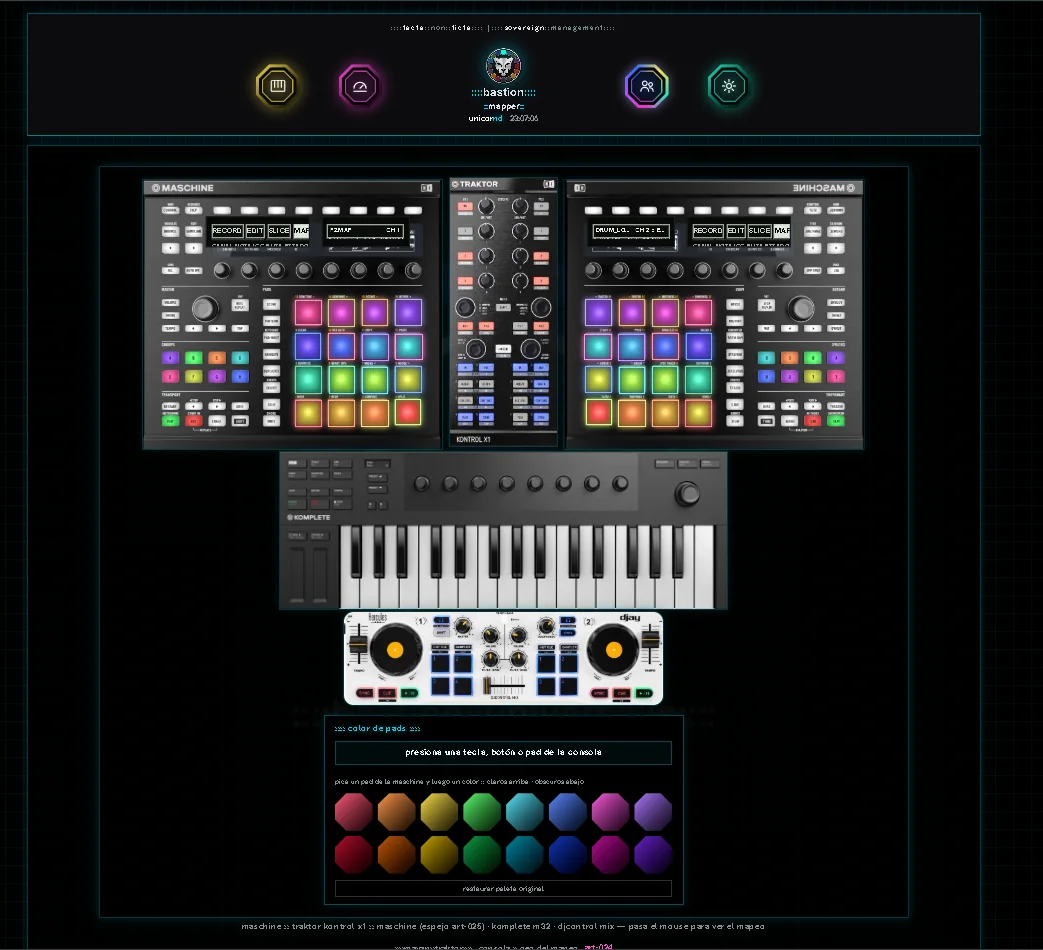
Load a virtual Traktor template, then press your own controller to replace each slot with local MIDI gestures.
Last event
4 · Export JSON
This is the portable record: device, channel, MIDI type, controller/note number, value, and the Mapping Universalis label you assigned.